Behind Negombo’s beaches lies more than 400 years of colonial history. The Portuguese, the Dutch and the British all fought over this small port, and you can still see their marks in the old fort gate, the canals and the grand churches. This guide covers the history and the best way to explore it.

In this guide
The Dutch Fort: a short history
| Year | What happened |
|---|---|
| Early 1600s | The Portuguese build the first fort at Negombo. |
| 1640 | The Dutch capture the fort. |
| 1643–1644 | The Portuguese briefly retake it, and the Dutch win it back in January 1644. |
| 1672 | The Dutch rebuild the fort. |
| 1796 | The British take Negombo without a fight. |
| Late 1800s | The British demolish most of the fort and build a prison on the site. |
What can you see today?
Not much of the fort survives, but what remains is atmospheric. Look for the arched gateway with a stone slab above it carved with the year 1678, part of the old eastern rampart, and the clock tower near the gate. The site is still used as a prison, so you can only view it from outside. It stands near the lagoon mouth and the fish market, so it is easy to combine with a morning at the market.


The Dutch Canal (Hamilton Canal)
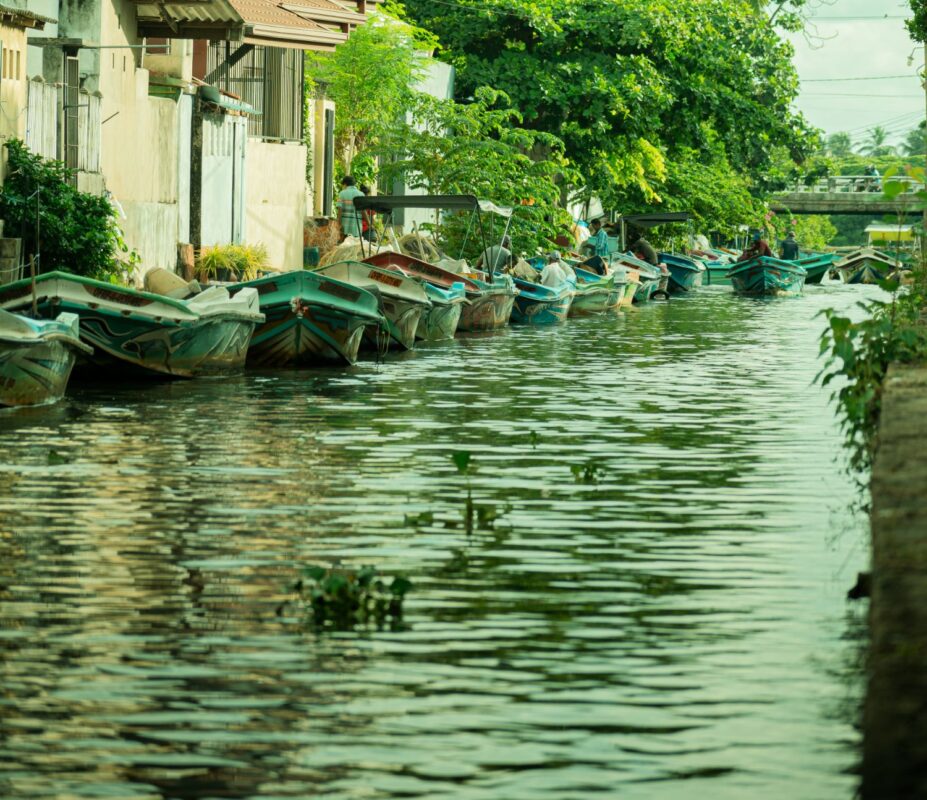
Negombo is famous for its canal, which locals and visitors call the Dutch Canal. The Dutch used inland waterways along this coast to move goods by boat. The section south of Negombo is officially the Hamilton Canal, built by the British in 1802–1804 and named after Gavin Hamilton. It runs about 14.5 km from the Kelani River near Colombo to the southern end of Negombo Lagoon at Pamunugama, and it helped drain salt water from the Muthurajawela marshes.
Today the canal is lined with fishing boats, homes and colourful houses. Our Negombo Lagoon Boat Tour starts right on the canal bank, and you can read more in our guide to the Negombo Dutch Canal.

St. Sebastian’s Church
A short tuk-tuk ride from the fort is St. Sebastian’s Church, a striking white Gothic Revival church modelled on Reims Cathedral in France. It was started in 1936 and completed in 1946. The church was badly damaged in the Easter Sunday attacks of April 2019 and was restored and re-consecrated just three months later. St. Sebastian is Negombo’s patron saint, and his feast is celebrated on the last Sunday of January.
A self-guided old town walk
- Start early at the fish market (best before 8am).
- Walk to the Dutch Fort gate and clock tower.
- Take a tuk-tuk to St. Mary’s Church on Grand Street.
- Continue to St. Sebastian’s Church.
- End the day on the water with a sunset boat tour along the canal and lagoon.
Visiting tips
- Do not photograph prison staff or inmates, and respect any “no photography” signs at the fort.
- Dress modestly for the churches, covering shoulders and knees.
- Mornings are cooler and better for walking.
- Carry water and small notes for tuk-tuks.
While you are in the old town, Angurukaramulla Temple is a good stop to add to the same day.
Frequently asked questions
Can you go inside the Negombo Dutch Fort?
No. The site is still a working prison, so you can only see the gateway and walls from outside.
How old is the Negombo Dutch Fort?
The Portuguese built the first fort in the early 1600s. The Dutch rebuilt it in 1672, and the gateway is dated 1678.
Is the Dutch Canal really Dutch?
Negombo’s canals date back to the Dutch period, but the stretch south of Negombo, the Hamilton Canal, was built by the British in 1802–1804.
Can I take a boat on the Dutch Canal?
Yes. Our lagoon boat tours start on the canal bank in Negombo.

Written by
Nalin Fernando
Nalin is the founder of Boat Tours Sri Lanka, a Negombo-based social enterprise that runs boat tours on the Negombo Lagoon with local guides. Nalin plans the tour routes and writes these guides from first-hand time on the lagoon, in the mangroves and around Negombo town.