Negombo is often called “Little Rome” (Punchi Romaya), and one visit to St. Mary’s Church on Grand Street shows you why. This huge Catholic church in the centre of town is one of the largest in Sri Lanka, and its painted ceiling is one of the most beautiful sights in Negombo. Here is what to know before you go.

In this guide
Why is Negombo called “Little Rome”?
Roughly two-thirds of Negombo’s people are Roman Catholic, the highest share of any large town in Sri Lanka. Many local fishing families became Catholic during the Portuguese period in the 16th and 17th centuries, and the town is full of churches, roadside shrines and statues of saints. That is how it earned the nickname “Little Rome”.
A short history of St. Mary’s Church
- Built over almost 50 years. Construction began in 1874 and the church was completed in 1922.
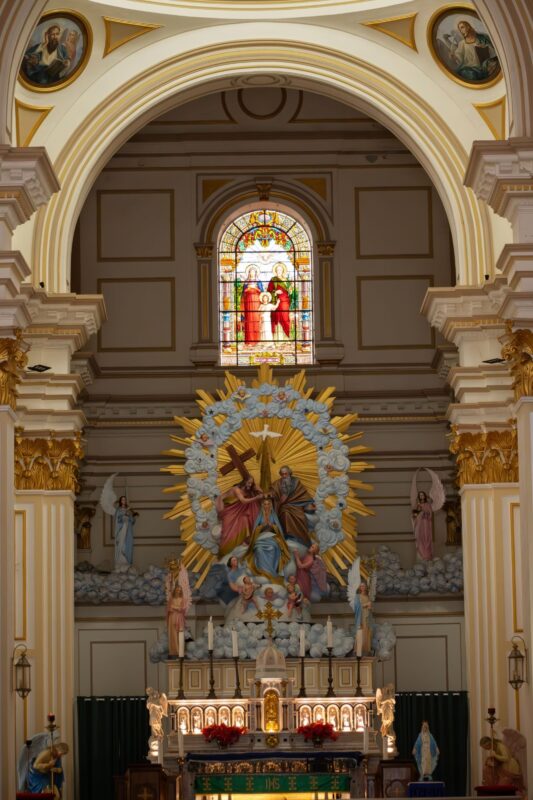
- Neoclassical style. The building has a grand columned façade, and statues of saints line the upper walls inside.
- The painted ceiling. The colourful ceiling paintings show scenes from the Bible, including the Creation and the life of Christ. They were painted by N.S. Godamanne, a local artist who was himself a Buddhist, a lovely example of Sri Lanka’s mix of faiths.
- A European altar. The main altar was imported from Europe, paid for by a local benefactor.


What to see inside
Take your time under the ceiling: bring binoculars or use your phone’s zoom to see the detail of the paintings. Look out for the many statues of saints, the altar, and the stained-glass light in the afternoon. Outside, the church sits on a busy street lined with small shops selling candles, rosaries and religious pictures.



Visiting tips
- Dress modestly. Cover your shoulders and knees, as you would in any church.
- Be quiet and respectful. St. Mary’s is a working parish church, not a museum. Avoid visiting during Mass unless you plan to attend.
- Sunday mornings are busy with local families attending Mass, which is a lovely sight, but quieter weekday visits are better for photos.
- Ask before photographing people who are praying.
- Entry is free. A small donation is always welcome.


Combine your visit
St. Mary’s is in the centre of town, so it is easy to combine with other sights:
- Walk or take a tuk-tuk to the old Dutch Fort and St. Sebastian’s Church.
- Visit the Negombo fish market early in the morning.
- Spend the afternoon on the water with our Negombo Lagoon Boat Tour or the Sunset Boat Tour.

Frequently asked questions
When was St. Mary’s Church in Negombo built?
Construction started in 1874 and was completed in 1922.
Who painted the ceiling of St. Mary’s Church?
The ceiling paintings are by N.S. Godamanne, a Sri Lankan artist.
Is there an entry fee?
No. Entry is free, though donations are welcome.
What should I wear?
Modest clothing that covers your shoulders and knees.
Why is Negombo called Little Rome?
Because around two-thirds of its people are Catholic, and the town is full of churches built since the Portuguese era.

Written by
Nalin Fernando
Nalin is the founder of Boat Tours Sri Lanka, a Negombo-based social enterprise that runs boat tours on the Negombo Lagoon with local guides. Nalin plans the tour routes and writes these guides from first-hand time on the lagoon, in the mangroves and around Negombo town.